
 Español
 Pусский
 Deutsch
 日本語
日本語 한국어
한국어 हिन्दी
 Indonesia
 Melayu
 Tiếng Việt
Continuous Flow Photochemical Reaction System
A continuous flow photochemical reaction system is a modern chemical processing platform that combines the advantages of flow chemistry with the use of light to drive or accelerate reactions. In this type of system, reactants are continuously pumped through a reactor where they are exposed to a controlled light source, such as ultraviolet, visible, or near-infrared light depending on the reaction requirements. Unlike traditional batch photochemistry, where the entire reaction mixture is irradiated at once in a flask or vessel, continuous flow photochemical processing allows for much better control over reaction conditions, improved light penetration, and more efficient heat and mass transfer.One of the main benefits of a continuous flow photochemical reaction system is the uniform exposure of the reaction mixture to light. In batch reactors, light may not penetrate deeply into the solution, especially if the reaction mixture is concentrated or strongly absorbing. This can lead to uneven irradiation, side reactions, and poor reproducibility. In a flow system, the reaction channel is typically narrow, which ensures that all molecules receive similar light exposure. As a result, reactions can proceed more quickly and with higher selectivity.Another important advantage is enhanced safety. Many photochemical reactions involve reactive intermediates, energetic compounds, or sensitive reagents that may pose risks under large-scale batch conditions. Continuous flow operation reduces the amount of material present in the reactor at any one time, which lowers the potential hazard. This makes the system particularly attractive for scaling up photochemical processes, especially in pharmaceutical, fine chemical, and materials manufacturing.Continuous flow photochemical systems also offer excellent scalability. Instead of increasing the size of a reactor, production can be scaled by running the system for a longer time or by numbering up multiple channels in parallel. This approach helps maintain consistent reaction quality while increasing throughput. In addition, the precise control over residence time, light intensity, temperature, and mixing allows researchers and engineers to optimize reactions more efficiently.These systems can be used for a wide range of transformations, including photocatalytic oxidation, photoredox catalysis, halogenation, cycloaddition, and radical-mediated synthesis. They are especially useful in modern synthetic chemistry because they enable access to reaction pathways that may be difficult or inefficient under conventional thermal conditions. By using light as a clean energy input, continuous flow photochemical reactors can also support more sustainable and energy-efficient chemical production.In practice, a continuous flow photochemical reaction system usually consists of a feed reservoir, a pumping unit, a light-irradiated reactor module, temperature control elements, and an outlet collection system. The reactor may be made of glass, quartz, or other transparent materials, or it may use specialized tubing arranged around a light source. Process parameters such as flow rate, wavelength, catalyst loading, and solvent choice can be adjusted to match the desired chemistry.Overall, continuous flow photochemical reaction systems represent an advanced and versatile technology for modern synthesis. They combine the benefits of photochemistry with the precision, safety, and efficiency of flow processing, making them highly valuable for both laboratory research and industrial production.
Products
Category:
-
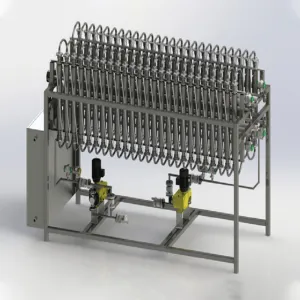
Continuous Flow Photochemical Reactor
Category: Continuous-Flow Photochemical ReactorsBrowse number: 847Number:Release time: 2026-07-11 15:42:05The continuous-flow photoreactor deeply integrates photochemical reactions with continuous-flow processes. lt shortens the optical path from the centimeter level of traditional kettle reactors to millimeter or micrometer level, greatly boosting photon utilization rate and reaction efficiency. Supported by a precise multi-channel parallel/series structure, reactants flow continuously and steadily under uniform illumination to achieve dual enhancement of mass and heat transfer, delivering industrial-grade reliable solutions for pharmaceutical,fine chemical and new material industries.
News
Category:
-
[Blog]LED Photocatalytic Reactor Application Fields
2026-08-14 03:21:53
Case
Category:
No search results found!
Video
Category:
No search results found!
Download
Category:
No search results found!
Job
Category:
No search results found!
Featured Products
-
NEWS
Continuous Flow Photochemical Reactor
Learn more



 WhatsApp
 Phone
Phone